It is the scenario every founder dreams of and every lead engineer fears: the "fail whale" moment. Your application has suddenly gained traction. Traffic is spiking, user registrations are climbing, and your engagement metrics are going through the roof. But simultaneously, your latency is skyrocketing, your database is locking up, and your error logs are bleeding red.
Scalability issues are, fundamentally, a sign of success. They indicate that you have built something people actually want to use. However, this validation comes with an immediate, high-stakes architectural ultimatum. The system that served your first 1,000 users is rarely the one that will serve your first 100,000. You are now standing at a fork in the road, facing the oldest debate in infrastructure engineering: do we buy a bigger machine, or do we buy more machines?
This is not just a budgeting decision; it is an architectural philosophy. The choice between Vertical Scaling (Scale Up) and Horizontal Scaling (Scale Out) will dictate your deployment strategy, your database management, and your team's operational overhead for years to come.
Defining the Players: Scale Up vs. Scale Out
To make an informed decision, we must first strip away the buzzwords and define the mechanics of these two distinct approaches.
What is Vertical Scaling? (Scaling Up)
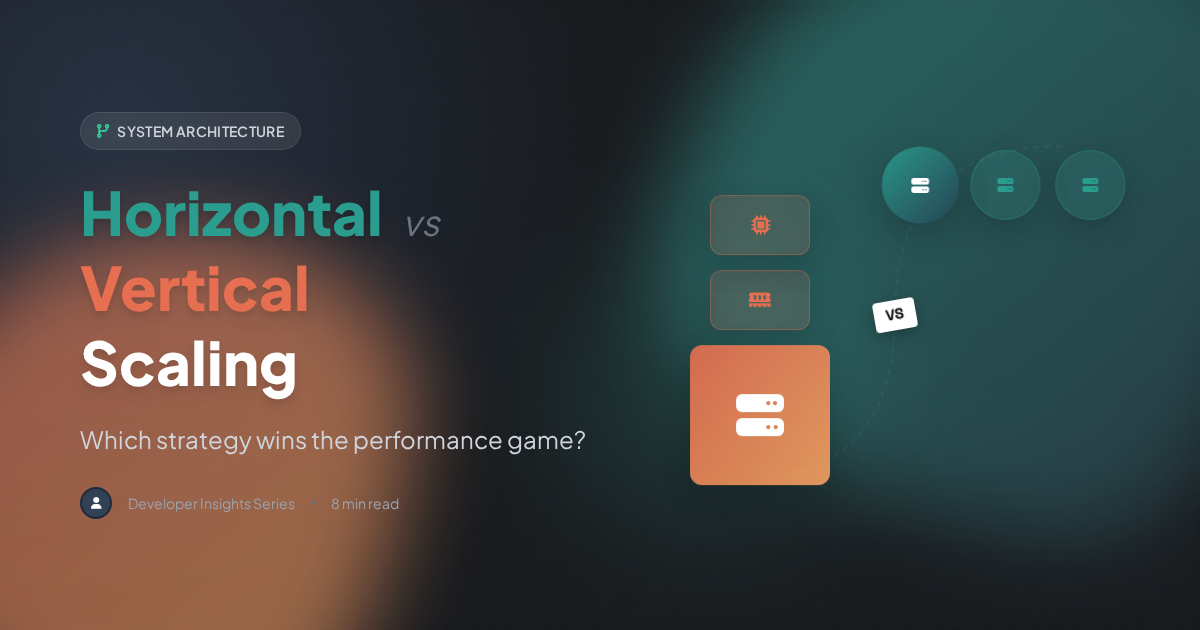
Vertical scaling is the process of adding more power to an existing server. It implies that your architecture remains relatively unchanged, but the underlying hardware is beefed up. In the cloud context, this is as simple as stopping an AWS EC2 instance and changing the instance type.
Imagine you are running a web server on a t3.micro. You are maxing out the CPU. To scale vertically, you migrate that same workload to a c5.2xlarge. You haven't changed your code; you've simply given it more RAM, more CPU cores, and higher IOPS (Input/Output Operations Per Second) to breathe.
What is Horizontal Scaling? (Scaling Out)
Horizontal scaling involves adding more distinct nodes to your resource pool. Instead of making a single server stronger, you add multiple servers to share the workload. This usually involves placing a Load Balancer (like NGINX or AWS ALB) in front of your application to distribute incoming traffic across 3, 5, or 50 different instances.
// Conceptual Difference in Logic// Vertical Scaling: Change configurationconst verticalConfig = { instanceType: "u-12tb1.112xlarge", // Upgraded from micro cores: 448, ram: "12TB"};// Horizontal Scaling: Change distribution logicconst horizontalFleet = [ "10.0.1.1", "10.0.1.2", "10.0.1.3", "10.0.1.4"];function getNextNode(request) { // Round-robin distribution const nodeIndex = request.id % horizontalFleet.length; return horizontalFleet[nodeIndex];}The Analogy: Think of your application as a logistics operation. Vertical scaling is like upgrading a delivery driver’s vehicle from a sedan to a Ferrari. It’s faster and more powerful, but it’s still just one car. Horizontal scaling is like buying a convoy of delivery trucks. Individually, they may not be as fast as the Ferrari, but collectively, they can haul significantly more cargo and cover more ground simultaneously.
Vertical Scaling: The Path of Least Resistance
Vertical scaling is often the default choice for early-stage startups and internal tools, and for good reason. It offers a path to better performance with minimal friction.
The Pros: Simplicity and Speed
The primary allure of vertical scaling is that it requires zero code refactoring. If you have a monolithic architecture—a single codebase handling authentication, payments, and business logic—vertical scaling preserves that simplicity. You don't need to worry about network latency between microservices or complex data synchronization. You simply pay for a better box, and your app runs faster immediately. It is the "easy button" of DevOps.
The Cons: The Hardware Ceiling and Downtime
However, physics and economics eventually intervene. Vertical scaling has a hard limit, often referred to as the "Hardware Ceiling." There is a finite amount of RAM and CPU you can fit into a single machine. Once you max out the largest instance your cloud provider offers (e.g., an AWS u-12tb1.112xlarge), you have nowhere left to go. If your application outgrows that box, you are effectively dead in the water.
Furthermore, vertical scaling presents a massive risk: the Single Point of Failure (SPOF). If your one massive server crashes, your entire business goes dark. Additionally, the act of scaling up usually requires downtime; you generally have to stop the instance to upgrade the hardware, forcing a maintenance window that disrupts users.
Horizontal Scaling: The Distributed Standard
When you look at the architectures of Netflix, Uber, or Google, you are looking at horizontal scaling. It is the gold standard for high-traffic, enterprise-grade systems.
The Pros: Infinite Scale and High Availability
The most significant advantage of horizontal scaling is theoretical infinite capacity. If traffic doubles, you double the node count. If it triples, you add more. There is no hardware ceiling because you aren't limited by the capacity of a single unit.
Equally important is redundancy. In a horizontally scaled environment, if one node crashes, the health checks on your Load Balancer detect the failure and immediately redirect traffic to the remaining healthy nodes. The user experiences no downtime, and the system heals itself (especially when coupled with auto-scaling groups).
The Cons: The Complexity Tax
This resilience comes with a steep "Complexity Tax." You are moving from a single server to a distributed system. You now need infrastructure to manage the fleet: Load Balancers, Service Discovery (like Consul or Eureka), and container orchestration platforms like Kubernetes.
While stateless applications (like a REST API) scale horizontally with ease, stateful components—specifically databases—are a nightmare. You cannot simply spin up five database instances and expect them to share data magically. You enter the realm of database sharding (splitting data across nodes), Read Replicas, and the CAP theorem. You must trade off between Consistency, Availability, and Partition Tolerance, dealing with issues like race conditions and replication lag that simply don't exist on a single machine.
The Showdown: Cost, Performance, and Maintenance
Beyond architecture, the choice between Up and Out impacts your bottom line and your daily operations.
Cloud Economics: Bill Shock vs. Optimization
Vertical scaling tends to scale your costs linearly or exponentially. High-end hardware yields diminishing returns per dollar; a machine with 128GB of RAM often costs more than twice as much as a machine with 64GB of RAM due to the premium on density.
Horizontal scaling allows you to utilize "commodity hardware." You can run your application on cheap, low-tier instances. If you are savvy, you can utilize Spot Instances (spare cloud capacity sold at a discount) because your architecture is resilient enough to handle a node disappearing. However, horizontal scaling introduces "network chatter" costs—data transfer fees between your microservices and databases can lead to unexpected bill shock.
Operational Overhead
The operational mindset differs entirely. Vertical scaling treats servers as "Pets"—you name them, you nurse them when they are sick, and you keep them running at all costs. Horizontal scaling treats servers as "Cattle." You give them numbers, not names. If a server acts up, you don't troubleshoot it; you terminate it and spin up a replacement automatically. This requires a higher maturity in automation and monitoring (Infrastructure as Code) but results in a far more robust system.
Verdict: It's Not Always Binary
So, which strategy wins? The answer, as with most things in engineering, is that it depends on your lifecycle stage.
- If you are an early-stage startup building an MVP with low traffic, stick to Vertical Scaling. It allows you to move fast, keep your team small, and focus on product features rather than Kubernetes manifests. Do not over-engineer a distributed system for 50 users.
- However, if you are scaling for enterprise SLAs, global availability, or millions of requests, Horizontal Scaling is mandatory. You cannot achieve five-nines (99.999%) availability with a single server.
The reality for most mature tech companies is a Hybrid approach. The most performant architectures often horizontally scale vertically optimized nodes. Instead of running 1,000 tiny micro-instances, they might run a cluster of 50 powerful machines to balance raw power with redundancy.
The takeaway: Start Vertical to survive the early days; go Horizontal to thrive in the big leagues.
Building scalable tools requires precision. At ToolShelf, we design our local-first tools to handle heavy lifting directly in your browser, effectively distributing the workload to the most powerful machine available—yours.
Stay scalable & happy coding,
— ToolShelf Team